
Beveling with a Bench Top Planer
I wrote an article about beveling with a bench top planer for Power Fibers last year. Here's the article with a few updates:
There’s a bench top planer in my shop that’s used to mill hardwood for rod tubes. The thought of using it to rough in tapered strips percolated for a while after seeing Tony Spezio’s setup for PMQ strips. I figured hex strips could be beveled the same way. Other makers have used a planer. Harry Boyd has experimented with a bench top planer in recent years. I’m sure there are others that I’m not aware of.
Following is a two part review of beveling with a bench top planer. Part I covers cutting a 60 degree bevel in an un-tapered strip. That can be done with a less expensive router beveller, but the planer will work if you don’t have a beveller. Part II explains cutting a taper into a beveled strip. Using the planer significantly reduces the amount of final hand planning.
Part I – Planing the Bevel
The first step is to straighten the nodes, sand or smash them and remove the enamel. The beveling process described here must start with straight nodes and a reasonably flat enamel side. I touch up the sides of the split strips on a power sander and run them through a router beveller to square them up. You don’t need a beveller to do this. They could be squared up with a hand plane, or saw the strips with a band saw instead of splitting them.
The squared up strips must have a 90* angle at one of the enamel edges to begin the beveling process. If you don't start with a reasonably accurate 90* angle (give or take a few degrees), the process described in this article will not produce 60* angles in the finished strip. I realize I’m beating this point into the ground, but if you don’t start with the correct angle, you’re just milling kindling for next winter.
Square up the strips to about the same dimensions so the planer height doesn’t have to be adjusted for every strip. The butt strips will be a little bigger than the tip strips depending on your target dimensions. Plan the rough cut dimensions ahead as usual.
Three different wooden forms are used in the beveling process. The first and second forms are not tapered and they have significantly different bevels. Both forms can be made with a table saw. Look up “forms” in the tips section at www.bamboorodmaking.com for more details on making wooden forms. The first form is functionally the same as a hand planers “first form”.
It’s critical that the enamel side of the strip is facing the short side of the first form with a 90* edge nestled into the form as illustrated in the drawing above. One pass through the planer will cut the first 60* angle. If the enamel side is not properly positioned, the strip will go in the scrap pile after one pass.
With the strip properly positioned in the form, set the height of the planer so that the rollers just touch the bamboo strip enough to pull the strip and form all through the planer at the same time. Don’t try to hog it off, the form may hang up in the planer and the sharp edges of the bamboo strip will cut grooves the drive rollers.
The height may need to be adjusted a couple times for the first strip until the cut is at the right depth. The goal of the first pass is to cut down to the enamel edge without reducing the width of the enamel side. That will take one or two passes through the planer depending on the size of the squared up strips. As the form and strip are pulled through the planer, carefully hold the strip down in the form as it enters the planer. It the strip pops out of the form as it enters the planer, the planer will ruin the strip. Here’s a photo of a strip after the first pass.
Note that the planer knives did not touch the surface of the form. There’s no reason for the planer to cut the strip that close to the form like you would with your final forms and a hand plane. I split most of my strips to .25 inches wide. So the bevel in my first and second forms is about .125 inches deep or one half the width of a split strip.
The opposite side of the first form is the second form. The second form has an un-tapered 60* equiangular bevel. The 60* angle of the strip should fit snugly in the bevel of the second form as illustrated below. One pass through the planer will produce an equiangular 60* triangle.
Place the strip in the form as illustrated above with the enamel on either side of the bevel. Adjust the height of the planer and feed the form and strip through the planer as described for the first form. Again, the goal is to cut flush with the enamel edge of the strip without reducing the width of the enamel side of the strip. Here’s a photo of a strip after one pass thorough the planer with the second form. Flip the strip and make a couple more passes through the planer if the angles aren't quite right.
The strips are now ready to be tapered. There’s no practical difference between using a planer or router beveller up to this point; but from now on, the amount of hand planning required to finish the strips is reduced significantly. I’ve been binding the strips at this point and heat treating before cutting the taper.
Part II – Planing the Taper
The strips have been heat treated; six packs have been selected, staggered, and cut to length. A couple extra inches have been added to the end of the staggered strips to allow for snipe. Most bench top planers will cut a divot in the last couple inches of the strip (i.e. snipe). It’s usually not enough to matter, but adding a couple extra inches eliminates the problem.
The third form is adjustable and tapered. A standard wooden planning form may or may not work. The form needs to be light enough for the drive rollers to pull it through the planer when they’re only touching the bamboo strip.
I made an adjustable form of white pine to keep it light and easy to make. My form isn’t as accurate as I would like but its close enough. Its 6ft long with a 60* tapered bevel cut on one side. This form can be made with a table saw. A router table with a 30* chamfering bit is perfect for cutting the bevel, but that could also be done with a table saw. As mentioned earlier, search the tips section at www.bamboorodmaking.com for instructions on how to make an adjustable wooden form.
The form depth is set to the final dimensions. It takes two or three passes through the planer to reach the roughed in target diameter. For the first pass, the height of the planer is set so that the drive rollers just barely touch the bamboo at the butt end - just enough to pull the form through the planer. That planer setting is noted as the start point for the rest of the strips. The form is fed into the planer butt end first. It won’t start cutting until the fourth or fifth station depending on the slope of the taper. It will cut progressively deeper from butt to tip. After the first pass, the planer will cut the same amount of bamboo from end to end.
Multiple passes are made with the first strip while stopping between each pass and checking the diameter until it’s at target. I’ve been stopping about 80 thousandths over the final dimensions of the taper. The planer height is noted at the target setting for the remaining strips. The rest of the strips are fed through the planer with two or three passes from the start to target planer heights.
The strips in this picture are ready for final planing. I was having trouble with splinters as you can see in this photo. But that problem was solved by soaking the strips in water a couple hours before planing them. Yes...I'm soaking the strips after heat treating. That doesn't appear to affect the quality of the finished rod. I just dry them in the oven before gluing up.
I don’t worry too much about keeping the knives razor sharp. Here’s a photo of a knife that’s planed the strips for eight rods. This knife could not be used for normal planer work. It would leave micro grooves and ridges in a piece of hardwood. This set of knives will only be used for roughing strips from now on with occasional sharpening.
Here’s a roughed in set of strips for several two piece one tip rods. Tapering the strips with the planer saved a lot of hand planning.
Here's a few final thoughts:
Pros:
1. Just about any inexpensive bench top planer will work so long as the knives are easy to change and relatively inexpensive to replace or sharpen.
2. The wood forms are cheap if you make your own.
3. The automatic feed feature of a planer is very cool.
4. A bench top planer is safer to use than most home made milling machines.
5. It only takes four or five passes through the planer to be within 80 thousandths of final dimensions starting with a squared up strip.
Cons:
1. An expensive planer may not work. If the planer has a high volume chip removal system, it will suck the strip up off the form and shred it. For example, the DeWalt 735 tends to shred bamboo strips.
2. Milling bamboo will ruin a set of knives. A different set of knives will be needed for other planning projects.
3. Hogging off too much may cause the form to hang up in the planer and the sharp edges of the bamboo will cut grooves in the drive rollers.
4. Most bench top planers are really loud. Hearing protection is advised in most cases.
One-stop machine for bamboo
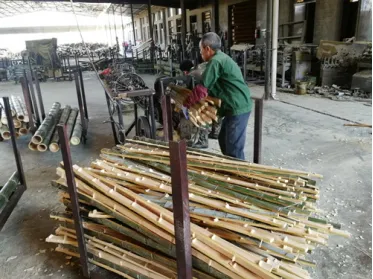
IN NAGALAND, bamboo based furniture is often made by local carpenters using inadequate hand tools.
Lack of dedicated machines at affordable cost has curbed the efforts of the local woodworker. Even removing the hard green covering on the bamboo has remained a challenge for many.
While more than 50 per cent of the bamboo species grow in North-East India, there are only a very few technologies to add value to bamboo.
An enterprising person by nature Mr. Imli Toshi, from Nagaland realized the need to build a user friendly machine that would handle different tasks in bamboo processing.
He developed a machinery/lathe for the removal of nodes and outer surface. When the design idea first crystallised in his mind, he built a simple prototype.
Next, he approached the National Innovation Foundation (NIF), Ahmedabad for funding and submitted his proposal and drawings.
Prototype
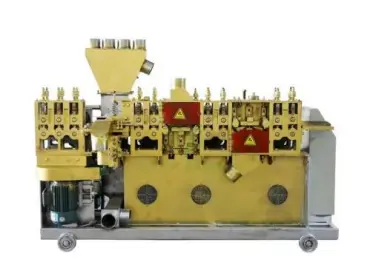
The prototype, named Arulepsa, developed with the help of the National Mission on Bamboo Application (NMBA) funding and NIF support, processes bamboo, removes the outer knots, smoothens’ the surface, while enabling wood carvings and final surfaces.
It can remove knots, do the planing and polishing of the surface and facilitate inner and outer contouring of the job.
Precision control
Precision control is achieved with a soft touch, four-way joystick linked to a robust electro-mechanical control logic kernel. The machine weighs 75 kg and is electrically operated using a one HP motor running on 230 volts AC supply.
Machine design
“It has been built with dedicated and independent sub-systems including the two stage planer, the bamboo feeder assembly, the self adjusting gripper assembly and two sets of fixtures for inner and outer contouring (carving).
“The planer assembly is the heart of machine and consists of a two-stage planer unit. The first stage achieves removal of the outer green covering and knots and the second stage makes the surface smooth.
Separate machines are provided for internal and external knot removal, slicing, making slivers, square bamboo sticks and a tool post accessory fitment for polishing them,” explains Mr. Toshi.
“The highlight of Mr. Imli Toshi’s equipment lies in using a single versatile wood processing platform that facilitates seamless removal of knots, planing, polishing and carving of bamboo.
The precision in work is achieved by deploying the dedicated control centre and a user friendly four way joystick,” says Prof Anil Gupta, Vice Chairman, NIF.
While conducting trials of his Arulepsa, Mr. Toshi noticed that there was a lot of bamboo dust/powder produced as waste material.
Water lifting device
Having an innovative temperament he made a composite material by mixing this powder with locally available resin to power a water pumping device.
Field trials were done using this the device in a small stream. A 20 feet long, 8 inch diameter feed pipe was fitted to the inlet channel of the device.
When the water flow hits the impeller, it rotates and the change of flux in the field coil induces the desired current. The arrangement of the magnets and the field coil was configured to produce 1 kW of electricity.
Breaking new ground
The Nagaland Bamboo Mission, purchased one unit of the machine while five units were also purchased by the Garo hills unit of the North East Region Community Resource Management Project.
Incorporating several improvements, the novel machines is breaking new ground in design, utility, elegance and social relevance in the field of bamboo.
For more details contact Mr. Imli Toshi Namo, Arkong Ward,1st floor, opp new market, Mokochung 798 601, Nagaland, mobiles: 094360-16086 and 098564-47485.
Share this:
X
Like
Loading...
BambooRodmaking Tips
< Home < Tips Area < Tool Building < Planing Forms < Grooving
To all Lurkers, Wannabe's, Newbies and anyone else who cares:
DO NOT be afraid to make your own planing forms. It's not that hard. Simply go by the instructions detailed so nicely by Thomas Penrose on his pages located through the Rodmakers Tips, Tools, and FAQs page.
One alternative means of cutting the groove which is quicker, is to use a jig and a lathe cutting tool like Bruce Conner uses on his wood form making page (available through the same Rodmakers page). ONE WORD OF CAUTION: when using the lathe cutting tool, be careful as its cuts the groove rather quickly and it is easy to over cut. I used metal cutting fluid, like "Tap-It" and things went smoothly. About every three or four passes I ran a triangular file mounted on a jig to even the cut out side-to-side. As you near final dimensions, use the triangular file alone.
An added benefit to this method is that you can increase the depth of the lathe cutting tool instead of adjusting the bars every few passes. You set the bars up per Penrose ONCE. Then go from there. You will have to be very careful on the tip side not to cut too much with the lathe tool as it will cut a .025" groove in no time flat! If you need a drill press, Harbor Freight (some curse the name!!) has their little drill press on sale regularly for about $49!! The capacity of the drill press throw is only 1-7/8" but that is enough to squeak by if you are careful. You can use the drill press later for other jobs.
Bottom line: With about $50-60 worth of hardware, 30 hours labor, and a drill press, you can make your own forms and can make them pretty accurately. If you have the patience to make rods, you can do this as well. I had zero metal working experience and had great success with the steel forms whereas the wooden forms gave me a lot of trouble - stripping threads, wandering groove, nicking the forms constantly. Go for it! (Rick Crenshaw)
When you taper a steel form, most likely you will use a 60 degree file glued to a block of plywood. If you do, use the same setup to make a 60 degree point. Chuck a short non-60 degree point in a drill press, and lie the file glued to the plywood on the drill press table, file side up. Run it along the chucked point to get the 60 degree point. If this is hard to understand, (it's hard to explain) contact me and I will try to explain further. (Mark Petrie)
Mark added the following after "talking" with him: The only other thing you need to know is to make sure the table is square to the chuck.
There was a question about creating the tapered groove on a planing form and whether to use a mill or the file/lathe threading cutter to create this groove. Here is an answer:
The short answer is stay away from the mill and use both the file method and the lathe bit method.
The long answer is this: The downside of using the file alone is that you have to adjust the forms constantly (and at 10 feet long, that would be a monumental task). Also, the file loads up easily and must be cleaned frequently. Finally, the file cuts rather slowly. The upside of the file method is that the file tends to cut a straighter line down the groove, with no chattering (wavy cut marks), and is very controlled so the cut is even on both sides. The upside of the lathe bit method is that it cuts very fast and you don't have to constantly adjust the forms - you adjust the lathe bit jig. The downside of the lathe bit is that you can easily cut more on one side than the other (which the longer cutting surface of the file eliminates), the bit tends to chatter if not pulled steadily, with constant pressure and good lubrication (which I suggest, use a good cutting oil like "Tap-It"), and you can easily cut too deeply. By combining both methods, you can cut quickly and precisely. Here's how it works:
Make sure your forms are filed flat on the inner surfaces where the bars meet.
Make sure your forms are filed flat on the top and bottom surfaces where the grooves will go. (per Penrose web page)
Make a jig with the longest straight part of a triangular file that you can find (make sure it's a true 60 *) and make sure the file section is glued true and flat to the jig. Break off the taper portion and save it for some other use. I used an old piece of Formica counter top to glue the file to. Shim with Plexiglas if needed to clear the bolts. You might need two sizes (depths) for such long forms.
Make a jig for a 60 degree lathe bit. (there is a design in "The Best of the Planing Form" and also on Bruce Conner's web page) Steel would be best, but hardwood is a decent choice. (this would be an ideal job for your friend with the mill.) The key points in making the jig are a) that it has a depth adjustment for the bit and b) that it has a true perpendicular mounting to the bottom of the jig. The bit needs to sit in the jig so that it is square to the forms on all axis - vertical, horizontal and lateral. I suggest using a large bit to help in cutting the deep grooves. 3/8" minimum, 1/2" is better. buy several - they are cheap and can be dulled after much use. Also, less likely to chatter when a sharp bit is used.
Choose the best location for measuring the gap relative to the bolts and mark the form precisely at 5" intervals from that spot along the length of the form.
Use a precise means of setting an ever widening gap in the forms. I think that feeler gauges are easiest and very precise. But if you are very careful you can use your dial calipers. Just make sure they are square to the inner surfaces of the form in every direction. I used .005" per 5", but use what you like best. Check, double check and triple check the settings to make sure adjustments down the line don't affect the ones you just set. I go over the forms at least twice, better three times. Make sure the tip end of the forms aren't spread farther apart than your file jig can reach.
Once your forms are set, you are done adjusting the forms with this method.
Set your lathe bit jig on the end of the forms where the forms are closest (this will be the deep part of the groove). Put some .01" or .015" shims (or whatever works well) under each side of the jig on top of the forms and set the jig to cut at this depth. Remove the shims and start cutting by firmly and steadily dragging the jig down the length of the forms. Of course it will only cut at the very narrow gap end. When it will no longer cut at the depth set, use the file jig to smooth out the area just cut. Try to keep the plane of the 60 degree jig parallel to the forms since the face of the jig will not be able to touch the surface of the forms.
Repeat step 8 until you have achieved the correct depth at the tip end of the groove. Cut carefully toward the end. The lathe bit can quickly remove too much steel on the shallow ends of the groove. Finish as usual with the file. (Rick Crenshaw)
I'm using Penrose's plans to build my planing forms.
I have filed down the forms to within .005 of final depth.
At station (00) is .080 to (70) .180.
The question is when setting the depth gage on the forms and zeroing, starting at 70 and running gage down form I have three stations that are not a zero.
Station (65) and (55) are .0015 low and station (25) is high .0015 to .002)
The final depth is to be (00) .085 and (70) .155. Everything other than this looks good. Just want to know if I am on the right track? (Jim Lafary)
If your work is that close, you deserve congratulations! Go get a good strong cup of coffee, or whatever other beverage floats your boat. Sit down for a minute with the better half. Watch your favorite football team win a bowl game today. Reach as far behind you as you can, and give yourself a good firm pat on the back.
Well done. (Harry Boyd)
PS - if you're already at .080 to .180, you might seriously consider quitting while you're ahead.
Good job, Jim. Harry suggested you quit while your ahead, but being of a rodmaker mentality he secretly knows that you will obsessively seek the ultimate refinement in your forms, possibly going to the other extreme. Resist the urge, and quit. You'll be adjusting the forms to the individual taper anyway. Now, I've just got to tell you, and Harry pointed this out to me once, that your forms are off anyway. Instead of increasing/decreasing the taper by .005 per 5" in your forms, you would have needed to increase/decrease the taper by .00577. See, you've ruined them already. ;o) (Martin-Darrell)
If I understand you correctly, you have another .005" to go more or less. If you look at the article in Power Fibers October 2001 issue and build the "File Plane" in the "Forms Tune-up" article you should be able to get the final measurements you want. I don't know how many have built a used the "File Plane" but Harry, Todd and myself have one. I've used it several times and it works, but then again I may be predigest, I designed it. B>) (Don Schneider)
A quick question about the planing form groove. Is it possible, through carelessness or a genuine lack of skill, to file off more on one bar than on the other, resulting in a groove that is not equilateral? Say, if my left leg is shorter than my right leg, or something, and I lean toward the left bar as I file away. Would that result in a groove that will not make true strips? (Jason Swan)
Yes and no. It depends on how much the sides are off in depth, and on how close to being closed the forms are. If you are only off a little, and the forms are open, the effect is to have the correct angle, with the strip pushed a little off center in the forms, which is of no consequence. If the forms are closed, the angles will be wrong. Sketch out the various scenarios and you will see what happens. (Tom Smithwick)
On second thought, I should have taken my own advice and sketched it out. It doesn't matter if one side is lower, even if the form is closed. (Tom Smithwick)
It seems that the forms do not have to be all that precise, and dimensional inaccuracies of the forms can be overcome depending upon how skilled you are with the plane, and I sure wish I was better with a plane. (Kyle Druey)
Although it doesn't matter if the groove is cut more deeply into one side of the form, it definitely matters that the top surfaces of the bars are even. If they aren't then your angles will not be true 60's. (Harry Boyd)
Right - That is a definite problem. (Tom Smithwick)
I'm making a lot of assumptions here, but I would think that the top and bottom of the bars would be filed before the groove is cut. Whatever it is that is used to cut the groove would follow or ride along the surface as the groove is being cut, so even if one side is lower than the other the groove would be cut so that the form produced an equilateral triangle. And I would think that if one side were lower than the other that one side of the groove would appear to be cut more deeply on one side than the other. (Darryl Hayashida)
I think there is some truth in what you say, but I also think the chances of rocking the plane if the stroke is not right down the middle increase, and I think it might be more difficult to set the form accurately as well. (Tom Smithwick)
The stroke will still be right down the middle, it's just that one side of the plane will be lower than the other. The plane will still be flat to the top of the form. I don't think one side being lower than the other will make a noticeable difference as long as it isn't way way off. Look at it this way. Orient yourself to the top of the form, assume it's flat. If it is in reality off, all you are going to see is where the bars come together, at the bottom apex, the split (which should be vertical) will be off a few degrees or so. In fact, I think anything less than the top of the form being 30 degrees from horizontal will still give an accurate strip. (Darryl Hayashida)
I think anything less than the top of the form being 30 degrees from horizontal will still give an accurate strip. (Darryl Hayashida)
OK, I agree with what you are saying. We were talking about two different things, I think. I assumed Harry was asking about a condition where the tops of the bars were not level with each other. That is, if you laid a straightedge across them, it would not contact both bars fully. (Tom Smithwick)
It's definitely possible (depending on how you file your groove). also possible is canting the plane to one side or the other, rendering your strips out of true (no longer and equilateral triangle). (Chris Obuchowski)
Try the trick of using a mirror at the end of the forms and you'll quickly see if you're canting the plane to one side. (Art Port)
After thinking about this for a little while, I don't see it as a problem unless the center falls in on of the beveled faces of the form when you open it up. If that is the case then the 60 degree point on the indicator would touch the form and if the point was damaged you would have difficulty setting your forms accurately. The bigger the strip and wider the form is set, the less likely this would happen.
Otherwise, assuming everything else is okay, you would get perfect 60 degree strips and as long as the apex is lower then either side of the groove, accurate too. (Tim Wilhelm)
Since the strip section is an equilateral triangle, it does not matter if you flip the strip, it will still sit the same way in the groove. (Tom Smithwick)
This brings up an interesting thought. Carried to extremes, this could put a "thin spot" in each strip, unless you took extra precautions to make sure the strip was pressed firmly into the groove during planing.
||
||
||
||
|| <--A
\\
\\
||
//
//
|| <--B
||
||
||
||
Assume your groove looked like the above. As you plane down the strip, I would think the "springiness" of the strip would make the strip tend to rise up out of the groove between A and B; flipping the strip as you plane could then plane away extra cane between A and B and result in a strip with a changed taper between A and B. Carried to extremes, this could result in a rod with a "wasp waist" similar to the old F-106 Fighter. (Claude Freaner)
Now, that is what I was feeling weird about! I just couldn't visualize it. If the top of one side of the groove (the deeper bevel) is farther away from center than the other side, then in effect, the strip will be sort of pushed in the direction of the deep bevel as you plane. Then, the opposite would occur when the strip is flipped. Isn't that right? So, the angles will be there, but the apex of the triangle will be off, so the center will be off. (Jason Swan)
It's all academic if your strips are coming out right, or at least within a thousandth or 2. If the measurements are any more different than that, then you got troubles. If you are in the process of making your forms now, then concentrate mostly on keeping the angles true to the surface of the form, if they wind up off center a bit, that won't hurt, as long as you can set the smallest dimension you need at each station. You can also take the forms apart and file the mating edge of the deeper side to bring it back closer to the shallower side. You can also do that to both sides if you have cut the groove too deep, I think it is better to take some off the sides of the forms than the planing surface, even if you tilt a bit with the file, the dowels or shoulder bolts will keep the top and bottom flat to each other. (John Channer)
My guess would be more that the file you used was not a perfect equilateral triangle to begin with. I went through 10 or 12 files before I found one that was truly 60-60-60. Most were off by at least a degree on two of the angles. One was off so bad it was a 57.5-59.5-63. Depending on how you glued it to your block, you could end up with any number of angles in your groove. And if you were to file from one end first, then swap ends and file from the other end, you would end up with a groove wider than 60 degrees.
Thankfully I had the luxury of using an optical comparator to accurately measure the angles (at work). Then, after I glued it to the block, I checked it to verify that the apex was exactly normal (perpendicular) to the flat of the block. I used Harry's file plane to get my initial groove, and have not yet put the final touches on it with my "calibrated" file block. Gotta get this first rod finished first.
BTW, thanks for loaning the file plane Harry! I will send back after returning from Montana. I really love the little six footer. It seems to have some excellent snap (haven't put a line on it yet). Tonight. (Troy Miller)
Looking through the RODMAKERS archives, I found a bit of discussion about cutting the groove with a lathe tool. Most of those considering it seem to have been making wooden forms. I did find one discussion, though, that said it could be done with cold rolled steel. What I didn't find were instructions on how to do it. Apparently there is a jig involved? Can anyone point me to an article or some other source to find out how to do this? I don't mind using a file, but it sounds as though the cutter idea might be quicker and less blister provoking. (Jason Swan)
I didn't have much luck with a lathe tool, others though seemed to get better results. What was a great help to me was making what is known as a file plane.
To file the groove using a file glued to a block of wood, you have to open up your forms the proper amount and then continue to adjust your forms since the depth of the file remains unchanged. With a file plane all you need to do is open up the forms once so a taper can be created and then you adjust the depth of the file as you cut the groove.
They aren't that difficult to make, but as you have seen in previous posts, you've got to use a little care to make sure everything is, as Troy said, normal. (Tim Wilhelm)
I had a machinist make me a holder for a 60 degree lathe bit, 3/8 shank. The two piece holder has two set screws to hold the bit and allow adjustment for depth of the tip. It is 1-1/2 wide by 4 inches long. I can use both hands to exert downward pressure. I made the holder of aluminum, its cheaper. The lathe bit worked great, final touchup was with a file.
I made my forms out of leaded steel. Much easier to drill, tap, cut and file than cold rolled steel. I frequently reversed the form as I was cutting the groove because I also have one shorter leg. or is it a hollow leg? (Bob McElvain)
Thanks to all the nice folks who offered suggestions to me on my groove problem. It looks like Chris is right, and my groove is off, though I don't know why. A couple of months ago I posted a question that foreshadowed this problem, and it seemed like the general consensus was that a 60 degree groove, even if it is off, is still a 60 degree groove. However, it seems that a groove that is offside offers significant problems to depth measurement. Now, after working over the other side of my forms I see that there are significant problems with the groove, where in some places one side of the form is beveled more than the other.
So, here is my question. It is a repeat, so I apologize for sounding desperate (I am!). Is there any way to fix a groove that is off? I am using a lathe bit tool that Harry Boyd kindly loaned me (thanks!), and a triangle file to smooth it up. Right now I don't have much confidence in the lathe bit tool since that is what I was using when I noticed the groove going screwy (don't know if it is the way I was using the tool or the bars). Any suggestions? Or is it time to start over? (Jason Swan)
I think you can save them if you clean up the groove and use it for the deep side. I would try to mount a triangle file on a block as Tom Penrose suggests. But I would make the block 1 3/4" wide, and screw runners to each side that hang down 1/4" inch or a bit more. Make sure the file is dead center in the block. These will ride against the outer edges of the bars, holding the file in the center. Now set the bars 1/4" apart, so that the outer edges of the bar are 1 3/4" apart. File away until the groove is even and centered. Then, set the taper into the bars, remove the runners, and use the file to cut to finish depth. All of this presupposes that you have not already cut too deep to pull this scheme off. (Tom Smithwick)
One of the things I noticed when working on the prototype for the Lathe Bit Plane was there was a possibility of cutting more to one side of the form if one was to aggressive with the cut and if the push force, if you will, was not parallel with the groove. The guides help to keep the tool lined up but are not a cure all. One thing I do when building forms is use the File Plane after each pass of the LBP to true-up the groove.
I think Tom Smithwick has a good idea to use a file to get you back on track. When Mark Wendt was building his forms his machinist friend cut the groove double depth and not a consistent slope. Rather than scrap the forms, nothing to lose and many emails between us a way was found to salvage the forms. Marks idea to establish a new baseline and I put together a Excel program to figure the settings. If you want a copy of the Excel Program let me know (get it here). (Don Schneider)
I'm building a Swelled Butt Form and about ready to cut the groove. I'm thinking of cutting the groove to drop .030" in 2.5" at the swell location when closed and no slope the rest of the way to the end of the form. This the right drop or should it be more/less. Your input deeply appreciated. (Don Schneider)
It's all in the eye of the beholder, of course, but I like to see somewhat more of a drop (or swell). I use the Morgan Hand Mill, but I set my anvil for a swelled butt that provides a .040" change over about 2.75" - 3" distance. The finished rod shows a nice, modest swell in front of the cork -- nothing radical, either in overall dimensions or in slope. (For rods of 8 feet and larger, I use .0050" over a full 3".)
I'm thinking that your resulting total of .060" across 2.5" might look nice in a very small rod, but would be barely noticeable (and perhaps too short) in a rod, say, 7 1/2 feet or longer. The proportions you suggest don't seem to be quite enough to create the nice, swelled effect you're probably after.
But, you know, you could try a couple test strips. Cut your forms to the .030" that you suggest and then plane just two strips -- strips that would be only a couple feet long, and of a dimension corresponding to, say, what you would have at the butt-end of a 7 1/2 foot rod for 5 weight line. Place the strips in your form so the swelled effect begins about 2/3 of the way towards the "grip" end.
When finished, just mate the two strips with your fingers and hold that profile up to the light at arm's length. The silhouette would be the full width of a finished rod, and will show you whether or not you have enough swell to please your eye. If not, you can always go deeper (and longer), as I have suggested. (Bill Harms)
After thinking about it, I believe you are correct, .030" over 2.5" won't be enough. I seldom, if ever, build a rod less than 7 1/2' anyway and the proportions may be more pleasing with a longer/larger swell.
The other concern I have is how the swell will affect the rod action. I'm thinking, a very dangerous process for me, a longer swell would give a more gradual transition of the power stroke of the cast to the rod. The additional length in this case may not be noticeable, but it is just a thought. On the other hand, a larger/shorter swell would give more of an abrupt transition. This is all probably hair splitting, so maybe I should just make it look good.
I'll take your advice and try .030"/2.5" on some test strips. I can always make the swell longer/larger. It is kind of hard to put metal back into the form though if I go to far :>) I don't mind building forms but am not thrilled with taping all of those holes !
What kind of swell proportions do others on the list use? Does someone have a formula similar to ferrule proportions for a pleasing look for swells? (Don Schneider)
I have access to a machine shop to build me some planing forms. The slop will be .001 per inch, my question is at what depth do I start my slop? (Ref. starting at tip end) (Galen Smith)
I'd start my forms at .025" and go to .085" (or .095" if 72" forms) for the tips, then start the butt slope at either .075" or .085” for longer forms. More than that, I would be dead certain that the machinist new exactly what you wanted. Many a good machinist has screwed up form making. It takes someone that REALLY knows what you want. (Harry Boyd)
The instructions found on Thomas Penrose's site suggest that the tip should taper from .025 to .095 and that the butt side be from .085 to .155.
Those are the numbers I shot for, but after planing a couple of rods, I would suggest reducing those numbers by .005. Why I say that, is because stations 1 and 15 (assuming a 6' form) are located 1" from their respective ends and in my opinion, particularly for those of us that have hand filed our groove, these are the stations that are mostly likely to have an error in them. That's because when we're filing, the block that the file is glued to isn't fully supported by the form, so there is an opportunity to cant the file out of alignment with the form. So Stations #1 & #15 are pretty much useless in my opinion. If you are having your forms machined that may not be an issue.
Another reason I would reduce those dimensions, it is that when setting a taper, I try to set the tip as far from the end of the form as I can. Ideally, I would like this to be Station #3. Of course that would depend on the rod length but that would give me 11" past the end of the tip that my plane can rest on as it comes off of the strip that is being cut. Plus that leaves me with some room to slide the strip up slightly if I need that extra .001 taken off of it. (Another reason I try to do that is because of how my work space is laid out. That end of the form is pretty crowded by another workbench.) unfortunately, I cut my groove a little deeper than what I intended and I am forced to use Station #2.
I'll reinforce what Harry suggested about machinists. I have a couple of friends that are machinists and normally when I ask them to make something they come up with ways to "make it better". I now have a vee block. If I could only find a caliper big enough and a welding machine to attach it to the jaws. (Tim Wilhelm)
Historically the smallest across the flats tip that I have seen or modern taper is a .052" - so if you were to start with a .025" depth you should be able to create any rod you chose into the future - as Doug Hall put it when making a 6' 3" #2 weight recently - "Damn Small" - that is the tip side - now for the butt side - that dimension isn't so clear to define - but keeping the thought that the forms can always be opened up - the smallest 2 piece taper that I know of uses a ferrule dimension of .135" so a start point dimension for the butt side might be .065" - again these dimensions are for very petite rod - but into you future of rodmaking you never know what tapers you might like to try.
Another issue that several have faced is that of getting a machinist to be able to understand the finished product - there have been several unfortunate stories shared here on the list of first production forms - be sure that whoever is doing the form fully understand what the end product is to be - take books and print out of web site pictures to them to reassure that they know explicitly what you want. (Wayne Cattanach)
I am at at the point in my Penrose forms where I am filing with a 60 degree file. My file is glued to a wood bloc
and I am closing the forms by ten thousands a each pass. It seems that I am filing one half more than the other. Could this be because I am pushing from one side all the time. Has anyone else ever noticed this as they were filing the forms. I haven't gotten very far yet, maybe halfway, so I can still correct any problems I am having. (Mark Bolan)
Go to my article on making wooden planing forms. The procedure for cutting the groove is the same for wood or metal forms. There are also two tools you can build to make the job easier and accurate. Several on this list have used the procedure and both tools to build their metal forms. If you have any problems, give me a shout. (Don Schneider)
Is your file glued to the block skewed to either side? That might make a difference. If you think the difference is caused by pushing or pulling too hard from one side, try reversing the direction of the forms -- in other words, flipping the forms end for end -- after every few strokes, or perhaps each time you close the forms up a little.
And let me echo Don's advice about the article on the Tips site... it's definitely worth the effort to make the tools he has described there. (Harry Boyd)
Files aren't perfect either! Someone wrote in awhile back about how far off triangular files can be. I proved him to be correct!! Mine had a bit of a twist to it and didn't track right. I cut out the good part and reglued it to the block. Works good now. (David Dziadosz)
I recently had a machinist friend mill the groove in my steel forms and I have found that their is an inconsistency between two stations.
The first station on the tip side is fine at a depth of 0.020" and then gradually tapers down to 0.040" at the fifth station, but at the sixth station it is also at a depth of 0.040". From then it tapers down 0.001"/inch as required (the last station on the tip side is 0.085", it should be 0.090")
He told me that the 0.040" at two stations doesn’t matter as you can compensate because the forms are adjustable? What are your opinions? Should I attack it with a 60 degree file on a block or just leave it? (Andrew Chan)
You can go either way. I really don't think you need to worry too much about the groove being .010 off, the forms are adjustable. What you do have to check is that the groove is 60 degrees the full length. Don't ask me how I know. I bought a set of forms that were professionally made locally. The first three blanks I made on them had very noticeable glue lines. I noticed that the glue lines were in about the same place on each blank. Checked the groove and found that it was less than 60 degrees in those areas. Cleaned the groove up with a triangle file and the forms are OK now. If the groove would of been greater than 60 degrees, the forms would make good pry bars. (Tony Spezio)
IMHO forms are a lot easier to use and do a better and more accurate job if they are made with a consistent slope. This is especially true on the tip side of the form.
When planning a strip, the cross section of the strip should be supported by the form more than half the depth of the strip. If it isn't supported properly you can very easily plane a twist into your final section because the strip will/can roll in the groove while planning. On tip sections you may not notice this condition until after glue-up and falsely blame your binder.
If you want to fix your form, I'll send you a Excel Worksheet off list. Just follow the instruction on the worksheet and it will tell you how to setup/fix your form.
I'm leaving Sunday morning on a two week cruise, San Diego to Fort Lauderdale through the Panama Canal. Be glad to help you when I get back if you have any questions. (Don Schneider)
Let me tag on to Don's reply. Don and I emailed back and forth when I was having problems with my forms, and he sent me his excel worksheet and it worked out great! My forms are now durned near perfect. I also got to use his form tools that Todd Talsma had, and let me tell you, they made fixing the forms very easy. Once you get the setup done correctly, it's just a simple matter of time involved in getting the forms done right. The tools and the spreadsheet made it easy. (Mark Wendt)
I just got my cold roll steel, set screws, shoulder bolts, dowels, etc. and I'm about to start. The only confusion I'm having, and I think I've read about every method there is, is how to put the tapered groove in. Thomas Penrose advocates the triangle file. I didn't understand Cattanach's method and I don’t understand the method in Jack Howells book with the lathe and how they set the taper. Which is the easiest method. Thanks a lot. also for the surface treating, mill bastard file or the India stone. thanks and I'm glad I found out about this forum. (Kris Fox)
The easiest method is with a 60 degree thread cutting tool. I have one fashioned in a block of rosewood that I used when I made my brass forms years ago. I will lend it to you if you pay the shipping and promise to return it. The last guy from the list I lent it to stiffed me on the shipping costs. (Marty DeSapio)
I'd highly recommend looking at the article written by Don Schneider either in Power Fibers or here. The article is actually written for making wooden forms but the groove cutting would work just as well for steel forms. It was about the clearest explanation that I've seen. No offense to any of the other descriptions out there but Don's instructions were a lot clearer to me. (Todd Talsma)
I just finished installing the last bolt in my 10' form. I need to know the best way to cut the grove in fear that I will screw-up all the time I've spent building this form. Some suggest the file method, "the lovely reed" suggests making a jig with a thread cutting lathe bit. A friend said bring over my first set of bar stock and I will cut the groove on my mill!!!!! Now that I'm on my second set of bars I won't be doing that again. (Mike Brown)
The short answer is stay away from the mill and use both the file method and the lathe bit method.
The long answer is this: The downside of using the file alone is that you have to adjust the forms constantly (and at 10 feet long, that would be a monumental task). Also, the file loads up easily and must be cleaned frequently. Finally, the file cuts rather slowly. The upside of the file method is that the file tends to cut a straighter line down the groove, with no chattering (wavy cut marks), and is very controlled so the cut is even on both sides. The upside of the lathe bit method is that it cuts very fast and you don't have to constantly adjust the forms - you adjust the lathe bit jig. The downside of the lathe bit is that you can easily cut more on one side than the other (which the longer cutting surface of the file eliminates), the bit tends to chatter if not pulled steadily, with constant pressure and good lubrication (which I suggest, use a good cutting oil like "Tap-It"), and you can easily cut too deeply. By combining both methods, you can cut quickly and precisely. Here's how it works:
1. make sure your forms are filed flat on the inner surfaces where the bars meet.
2. make sure your forms are filed flat on the top and bottom surfaces where the grooves will go. (per Penrose web page)
3. make a jig with the longest straight part of a triangular file that you can find (make sure it's a true 60 degrees) and make sure the file section is glued true and flat to the jig. Break off the taper portion and save it for some other use. I used an old piece of Formica counter top to glue the file to. Shim with Plexiglas if needed to clear the bolts.
You might need two sizes (depths) for such long forms.
4. make a jig for a 60 degree lathe bit. (there is a design in "The Best of the Planing Form" and also on Bruce Conner's web page) Steel would be best, but hardwood is a decent choice. (this would be an ideal job for your friend with the mill.) The key points in making the jig are a) that it has a depth adjustment for the bit and b) that it has a true perpendicular mounting to the bottom of the jig. The bit needs to sit in the jig so that it is square to the forms on all axis - vertical, horizontal and lateral. I suggest using a large bit to help in cutting the deep grooves. 3/8" minimum, 1/2" is better. buy several - they are cheap and can be dulled after much use. Also, less likely to chatter when a sharp bit is used.
5. Choose the best location for measuring the gap relative to the bolts and mark the form precisely at 5" intervals from that spot along the length of the form.
6. Use a precise means of setting an ever widening gap in the forms. I think that feeler gauges are easiest and very precise. But if you are very careful you can use your dial calipers. Just make sure they are square to the inner surfaces of the form in every direction. I used .005" per 5", but use what you like best. Check, double check and triple check the settings to make sure adjustments down the line don't affect the ones you just set. I go over the forms at least twice, better three times. Make sure the tip end of the forms aren't spread farther apart than your file jig can reach.
7. Once your forms are set, you are done adjusting the forms with this method.
8. Set your lathe bit jig on the end of the forms where the forms are closest (this will be the deep part of the groove). Put some .01" or .015" shims (or whatever works well) under each side of the jig on top of the forms and set the jig to cut at this depth. Remove the shims and start cutting by firmly and steadily dragging the jig down the length of the forms. Of course it will only cut at the very narrow gap end. When it will no longer cut at the depth set, use the file jig to smooth out the area just cut. Try to keep the plane of the 60 degree jig parallel to the forms since the face of the jig will not be able to touch the surface of the forms.
9. Repeat step 8 until you have achieved the correct depth at the tip end of the groove. Cut carefully toward the end. The lathe bit can quickly remove too much steel on the shallow ends of the groove. Finish as usual with the file. (Rick Crenshaw)
I did it with sections of triangle files that were glued into inlets cut into a wooden block. You should be aware that all triangle files are not created equal. If you choose this method, take your thread gauge (60°) with you and check all the files at the store. I used first a bastard cut, then a second cut, then a finish cut, followed by a triangle India stone and oil. The India stone was dead on 60°.
I cut the full length of a hard maple 2 x 4 and planed it all so that I had the same material thickness for all four blocks. Then I cut the dado inlet throughout the full length, then cut into shorter pieces. You may find that some of the inlets will require more depth, so don't take your rip fence down 'till your sure.
To adjust the forms I used machinist's bore gauges, though this will not give you quite the exact amount you will need between stations, as you will only be able to increase by thousandths, and not the fractions needed to actually have a true ratio. For a more detailed explanation of this see Thomas Penrose's site. (Martin-Darrell)
I've been working on my forms steadily for about a month now. After drilling and tapping my holes, I find out that it's too tight and so I take it to a machinist to give it a little shimmy room. Problem solved. Then I file each flat to prepare for the groove. No problem. Now, I've got a 2 x 2 with a groove routed in it and I've epoxied the triangular file into it and that's all I'm going to use for the time being because I figure it's foolproof. Maybe more work, but foolproof. So I measure as I'm taking material off with the dial indicator and I would assume that regardless of the fact that the forms aren't closed, that I would still get measurements that have a difference of .005 from station to station, correct? Also, the base for my indicator does not sit flat on the forms for some reason. How could it possibly have gotten that misaligned especially since I filed AFTER I got it back from the machinist. Any help would be appreciated as I am extremely frustrated at this point. (Kris Fox)
I feel your frustration! One thing I did to help get accurate measurements at the stations was to close the forms all the way, and measure the outside edges of the forms with my caliper. With the forms all the way closed, I set the width of the forms to "0" on my caliper. Then, I marked the width of any stations that were not "0" with the forms closed on a piece of masking tape, on the bench. This established a consistent reference. From there, I could get a more accurate reading of the gap by measuring the outside width of the forms after each adjustment. Took a little more time, but since my groove was so screwy, I had a hard time getting accurate measurements from between the bars.
BTW, the .005" slope between stations is correct. However, if you are measuring it with your depth indicator, sliding it along the length, you may not be getting accurate readings. I know the Penrose site says to slide the indicator down the bars, hoping to see no change after the groove is done, however, when I tried that the measurements changed slightly (+/- .002"-.005") because my groove was a bit off center in some places, and the point would ride up a bit on the bevel.
Also, after the groove is finished, you should have that .005" groove slope only when the bars are perfectly parallel, either closed or open. So, if you want to test that slope with the forms open, you'll need to make sure each station is reading the same width.
Finally, one of the most frustrating things for me when I built my forms (didn't do so good, and I actually need to do them again) was realizing that my flat filing may have been flat, but tended to cant to one side or the other as I worked. The end result was a bit of a high spot near the middle of the forms, and some funny bevels to the top of the forms. Rats. That may explain why your depth indicator doesn't sit flat. Or your indicator base isn't flat. One or the other.
Good luck. I hear the frustration goes away after a while...(Jason Swan)
You're looking at it the wrong way. You're not frustrated, instead you have been blessed to find a hobby where the fun just won't quit. You've only scratched the surface of all the great joys you will be experiencing. ;^)
Now, seriously, a couple of ideas that might help. First, one end, the tip end, has a smaller groove which also means that for each .001" of depth there is less material to remove. The butt end, has more surface in contact with the file, so it takes more effort (passes) to cut .001" of depth. That may not be any of your problem and you may have realized that early on in the process, but since the obvious things are quite often the most difficult to see, I thought it warranted saying.
As for the indicator not setting flat, there may be a cause that you can fix. Before you started, did you put the indicator on it and if so, was it flat then? As you file, a burr is turned up along the edge of the groove. I don't know if you are always filing in one direction, say left to right, but if you are I think the side of groove closer to you will have more of a burr. Remember that the teeth of the file are at an angle to the axis of the file. As you move the file left to right, the cutting action of the side closest to you is upward while is the cutting action on the opposite side is downward.
Now a lot of the above is pure speculation on my part. Looking at a file, it would seem true and