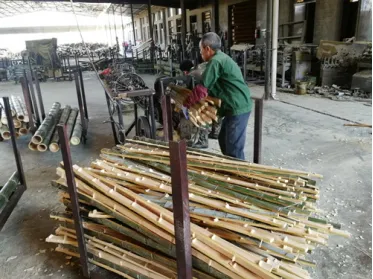

Bamboo Strip Precision Planer Machine
Function: Special equipment for further precision planing of bamboo strips after rough planing and drying.
Product Description
Bamboo is celebrated for its sustainability and versatility in various applications, from furniture to flooring and even textiles. The bamboo strip precision planer machine is a critical piece of equipment in the processing of bamboo, designed to produce uniform and smooth bamboo strips with high precision. This machine is essential for manufacturers who need consistent, high-quality bamboo strips for further processing or direct use in various products.
Function: Special equipment for further precision planing of bamboo strips after rough planing and drying.
1.Spindle speed: 11700 rpm
2.Voltage :380V
3.Power :18.4 KW
4.Feeding speed: 63m/min
5.Dimension :2000 L*800 W*1100 H mm
6.Weight : 1000kg
Applications of Bamboo Strip Precision Planer Machines
-
Furniture Manufacturing: Producing consistent and high-quality bamboo strips for making furniture components, such as legs, panels, and frames.
-
Flooring and Paneling: Creating uniform bamboo strips for use in flooring, wall paneling, and other construction materials where precise dimensions and smooth finishes are crucial.
-
Crafts and Decorative Items: Preparing bamboo strips for crafting intricate designs and decorative items that require fine detail and smooth surfaces.
-
Industrial Applications: Supplying high-precision bamboo strips for various industrial uses, including composite materials and specialty products.
BambooRodmaking Tips
< Home < Tips Area < Planing < General
Put blocks under your planing form to elevate it off the work surface so you can reach under it. It really helps in holding strips in place, in general cleanup, and in comfort. (Ralph MacKenzie)
How many blocks do you use? Do you find that your form has a tendency to deflect in the center as you plane? If it does deflect does that cause problems? My guess is that you would have to support it more than just at the ends. Maybe every 12 to 15 inches. (Tim Wilhelm)
I use one block under each end of the form. I have not noticed significant deflection, but I haven't put a dial indicator on the middle looking for it, either. Steel is pretty strong stuff! Even if it did deflect a thou or two (and that's about all it would be doing, if anything), the groove would seem to me to still be "on dimension". It really does make handling the strips a whole lot easier for me, and I can keep stuff handy right under the form. My "bench" is a 2x6 with a 1x2 on each edge creating a small lip, so I don't have a lot of extra space for stuff. Gotta have STUFF! (Ralph MacKenzie)
My forms have a block near each end, one in the approximate center, and one in between those on the ends. I machined them out of aluminum so that they have an L-shape. This way every other one is turned the opposite direction so that the forms are held in place by the leg on the block. They raise the forms 1" above the work bench. Makes it much easier to hold the strips in place using that wonderful gift of the opposable thumb. (Martin-Darrell)
A great tip is to make a Medved beveler and make your untapered 60 degree strip.
To help maintain a level plane, start it off level. The way I do this is to place the rear of the plane on top of the form and the toe on the end of the cane. I know my plane is flat and my form is flat. When the blade contacts the cane it is exactly parallel to the form. Lift the rear of the plane from the form and keep it level and move forward. Plane away!
I am currently working on being able to mount a small bubble level to the plane. This will insure a level plane is kept level on those late nights. (Adam Vigil)
Jack Howell in “The Lovely Reed” points out that standing a mirror at the end of your form will accomplish the leveling of the plane ( and in a continuing way, not just at start-off I might add, as "leaning into" the planing action often changes the plane's attitude with respect to the form) and says that that bit of insight is worth the price of his book. I had had some problems with the plane drifting off-level and it certainly helped me! Do it for a very short while and your wrist "learns" the correct feel holding the plane. (Art Port)
I have tried all the various gloves for holding the bamboo in the form while planing, only pigskin holds up to the sharp edges of the bamboo. It's very durable and protects my hands very well. (Bob McElvain)
Do any of you wear gloves to protect your hand when planing? I used to get sliced up quite a bit and I use some leather work gloves now, but I remember reading in a post not long ago about some rubber gloves from an OSH store. I don't know what an OSH store is so I'm just wondering what you use for gloves. (Hal Manas)
I think OSH stands for Occupational Safety and Health. And as for wearing leather gloves when I'm planing; too bloody right I do! Like a lot of the other guys, I learned to do that the hard way : ) (Mike Roberts)
The OSH I mentioned stands for Orchard Supply & Hardware, a chain store we have here in the states. The gloves are called "Cut" gloves and sold under the Stanley brand name but I seen them sold under a few other names as well. They're probably made in China or India. They're simple white canvas mule gloves that have been dipped in a course rubber coating. Not to be confused with the chemical resistant gloves that also rubber. They are also great for gripping things like a stuck pair of ferrules and such. (Chris Wohlford the Ultimate Bamboo Fly Rod Library)
I never wear gloves while planing. Just lucky, I guess. (Harry Boyd)
No gloves!! I protect my hands, when I can, by being careful. When I am not careful, I often pay the price. But, I never needed to make the same mistake more than two or three hundred times before I learned. Nevertheless, no gloves!! (Bill Harms)
I probably should explain my earlier post. Even the thinnest latex gloves like the proctologist wears prevent a great deal of tactile sensation. I don't know how to say this without sounding like I'm bragging, so I'll just plunge forward. I can really feel what's going on as I'm planing. If the strips are a thousandth above the form, I can feel that. If the strip slips as I'm planing, I feel it, and know that it's either time to sharpen or to back the plane blade up a little. If there is a bump at a node, I can feel it better than I can see it. If the grain is tearing at the node, I feel it, not just see it. To enhance that sense of feel, I wear no glove or any kind of protection on either hand.
My hands aren't as tough as Channer's, no question. In fact, they are soft as ladies hands. I don't even wear gloves when splitting. Yes, I get some cuts and splinters, but no one ever said making rods was pain free. Again, I like being able to feel what's going on. I did have a problem about two culms ago when I sliced my thumb pretty good and got blood all over the bamboo. But blood doesn't soak into the enamel very well, so nothing was lost. :-)
I just got a beveler a few weeks ago, and I did wear finger cots while operating it. And I wear heavy gloves while flaming because the cane gets too hot to handle. But those are about the only times I concede the need for gloves.
Even though I constantly warn beginners in my articles that bamboo will cut you in a hundred different ways, I'd suggest that you wear gloves only as little as you feel is necessary for safety. Not from a macho standpoint - "Be Tough!", but from a touchy, feely perspective. (Harry Boyd)
You can also "hear" the sound your plane makes when every thing is right . . . or wrong! I empty the mouth of my plane after every pass. The shape of the chips tell you what's going on at the cutting edge. (Ted Knott)
If the strip is putting up a struggle it's time to sharpen the iron. (Tony Young)
Way back in '09 when I used to plane on the forms, I never did use gloves. The finger cots were good for holding the strip in position in the forms with less finger pressure. I rarely cut myself, and only occasionally got splinters. The only time I use gloves now is when I'm roughing with the power beveler. I've completely shredded gloves in this manner, despite trying my best to keep a good grip. (Martin-Darrell)
I used to wear gloves but put that practice aside as I found it awkward for final planing, although once in a great while I wear them for splitting. I have hardly ever cut myself, now splinters, that is another matter. (Bret Reiter)
One big advantage of clamping the strip is that you can usually dispense with the gloves without getting cut. If you are down nearly to the forms, the strip may in fact just slip forward, but you aren't holding it with your fingers.
At that stage, I just put a little piece of that sort of non skid plastic stuff about 1" X 1/2" between the strip and the clamp. I have no idea what it's called, but it's absolutely everywhere, and it's as cheap as chips. This stuff has a million uses on the workbench. (Peter McKean)
Kevlar gloves here. Only on the left hand while planing and both hands while running the beveler. No cuts but splinters can get through the mesh. They breath and do not restrict the hands at all. (Adam Vigil)
I wear one glove on the left hand while holding the plane in my dominant, right. It handles all the bamboo holding and touching. It is calf skin not too unnatural. I can pick up things. It protects me from all cuts and 99% splinters. I never slide my finger up the form with a bamboo split in it. They are usually sharp enough to cut. I did this once and it was like running my finger on a blade, I drip stained my bench but no stitches. (Rex Tutor)
I have said it before here, but once again-----
I do not like to wear gloves at all. Yes I have cut myself numerous times, and had more than my share of splinters, but with experience, one learns not to do those things that contribute to injuries. The only time I use gloves at all is when I am working with a tough piece of cane, or a dull blade (never), and I need to hold the strip precisely. Then I use a latex surgeon's glove on my left hand. Works for me, but if you have tender hands, then maybe welders gloves are best. (Ralph Moon)
I use rubber finger tips that you can get at office max. They allow me to grip the cane better than gloves when I'm planing. (Tim Stoltz)
I like the Atlas "Fit" gloves from Home Depot. Cloth on the back - blue rubber on the fingers & palms. Not as good as leather in terms of protection, but you can pick stuff up with them & get a better grip than with bare fingers.
When planing, I wear a glove on my left hand. Helps hold the strip in place & you don't get splinters. No glove on the right hand that holds the plane. I wear gloves on both hands when splitting. (Tom Bowden)
It has just been brought home to me this afternoon that just because a lesson happens to be one that you have learned many times before doesn't mean that it's not still worth learning.
Here is my best piece of advice, my very best....
When you are having trouble with a strip, any kind of trouble at all, and it's not doing what you want it to do nor going the way that you want it to go, STOP.
Take the blade out of your block plane, and no matter whether you have just sharpened the bloody thing six passes ago, SHARPEN IT . Take your time. Do it properly. I am talking mirror surfaces here!
Then go back to your problem strip, and if you are like me, you will find that about nine times out of ten the problem has gone away.
Cane gremlins are frightened of sharp edges; either that or they have some doubts about the stability and safety of the kind of people who sharpen them that obsessively.
And maybe, just maybe, the time it takes to resharpen might give you a little breather in which to think about why the glitch happened in the first place, to have a cup of tea, let the dog out for a pee, say hello to your wife, and generally defragment the old disc (the gray, floppy one beneath your hat, that is).
I don't have any idea what you do if you are not a hand planer. I guess that you never have problem strips in the first place, maybe. (Peter McKean)
I have finally gotten to the point which I felt was the hardest thing for me as a new rodmaker. That is allowing the plane and its own weight do the work. The wrist and hand are not as sore lately. :-) (Jim Tefft)
Big step. Of course it's possible that you've also developed some additional muscular strength in your planing arm! (Harry Boyd)
Try a bench plane and holddown clamps, like Tom Smithwick's pictures a couple weeks ago. Definitely the way to go. You will be able to plane as long as you want with no pain at all. (Darryl Hayashida)
For those that are using bench planes, do you get a lot of chatter? I'm presently using a LN # 3 and enjoy it. I take the cane within about 0.020" of the forms and switch over to a Record 9 1/2 for the final cuts. Seems like it takes about 2 passes/side so that the 9 1/2 will take a full curl. The first 2 passes after the LN the cane comes off in short segments. It happens on both side and for the last 2 rods.
Any ideas? (Don Anderson)
It sounds to me like your forms are not level. The shorter plane is following the irregularities, and the long one is straddling the dips. Chatter is a very unlikely problem with a Lie-Nielsen, but if you had it you would see the marks on the cane surface. If you have a smooth surface, you don't have chatter. (Tom Smithwick)
The LN #3 does take a full curl cut of 0.004". The 9 1/2 takes a 0.002" cut. Not sure about the forms not being level. A straight edge says they are. Will check them again. (Don Anderson)
Does anyone use the little LN #1 Bench plane ? It's mighty cute! (Marty DeSapio)
I have one, and like it. It's good for finishing up, but too hard to hold for all the time use. If you are only going to get one plane, get a #2 or a #3. They are much more substantial tools, and make the work easier. (Tom Smithwick)
If you are having trouble with keeping the apex on top, I fought this for a long time, about gave up hand planing. Then I discovered that the blade on the Stanley 9 1/2 was sticking down further on one side than the other, regardless of how you adjusted it right or left. I took the plane apart, and filed on the throat, until the blade sticking out the bottom was a nice level edge all the way across. ( You need to assemble the plane and check the blade that way each time you file on the throat). I have zero problems keeping the strips at 60 degrees now, and my rods have never had tighter joints. It made all the difference. Hope this will help someone somehow.
I also use a portable planer to reduce my strips to workable dimensions, and no longer have a need for rough planing. It's really helped out quite a bit. (Jerry Andrews)
Since I haven't gotten around to making a really nice set of planing form risers, thought you might want to know a cheap, cheesy looking, but great working setup. I cut three 2 x 4's to about 6" long, picked up a roll of that non-slip shelf liner from Wally World, and a can of 3M 77 spray, also from said Wally World. I outlined the 2 x 4's on the non-slip, two pieces for each 2 x 4, for the top and bottom. Then sprayed the 3M 77 in a nice dust coat on the 2 x 4's, and pressed the non-slip on both sides. Works like a champ. The blocks won't slide on the bench top, and the planing form won't slide on the blocks. The 2 x 4's are high enough to fit spring clamps onto the planing forms, and it lifts the planing forms high enough so that planing is quite comfortable. Someday, I'll probably get around to building a high tech planing form riser setup, but hey, these guys work just fine for now. (Mark Wendt)
This is something that most of the guys that have been making rods are aware of, but could be really frustrating to some new guys/gals.
If you are getting areas that look like chips at the nodes, it might be. But again, it could be something other. If, you straighten your strips, and do NOT get the node area flat, both top & bottom and on the sides, the area NOT flat on the sides, can create a void, that will run from the plane. Even in the form, it will run from the plane, and ALWAYS be a void. Then upon glue up, it appears as a chip, or an area that appears to have been ground away by the rod binder. ( I thought initially it was my binder supports smacking them, which they can, but I'd bet it's the node preparation). So before planing, sight down the strips, and if the node has a " toss" in it, side to side, get it out of there before that strip goes into the form. It can haunt you! Mechanically, the plane blade CAN'T reach the area with the dip. It will glide over it, and when the cane sinks lower and lower into the final dimension, the " dip " will now be below the surface of the other cane that has been planed. Think about it. It's on the enamel side as well, and THAT'S where it's gonna show! (Jerry Andrews)
Hey, warning to the newbies! They never tell you about the cramps in the hands. I was planing some scarfs for a nodeless I’m building and my thumb cramped. The sucker bent over in a right angle and caused me to &*^%%$#@ a blue streak. It has been 2 days now and the muscles to the thumb are still sore. (Jim Tefft)
One of the reasons I use a clamp to hold the strip and a two handed bench plane. A bench plane is also easier on the arms and shoulders. (Darryl Hayashida)
There is a condition known as 'joiners thumb' or 'carpenters thumb' which is akin to a form of repetitive strain injury. I know of one old rod builder now in his late eighties who has had to stop building rods because hand planing is just too painful - true! (Paul Blakley)
Foul, foul, foul! Jim didn't you take the newbies oath and sign the rod builders nondisclosure statement prior to building your first rod, we can't be telling new builders that building cane rods can be hazardous to your health, now you'll be branded a rebel just like Bob Nunley, who has elected to freely share his mishaps with the rest of us. (Bob Williams)
Bob doesn't just hurt himself, he's elevated self-injury to an art form. I've witnessed his skill in this area with my own eyes and quickly realized I was in the presence of a master. He didn't actually hurt himself on this occasion but his talent in this area was clearly demonstrated.
It was early this year in the days leading up to the "Real SRG" in NZ, and Ian Kearney had taken Bob and I out for a spot of late afternoon fishing. It was a bit of a drive to our destination, so a couple of the local ales were sampled along the way, with the usual results: Bob felt Nature's call and wandered off to "see a man about a horse".
Now, unlike the land of Oz, New Zealand isn't crawling with all sorts of nasties which bite you, sting you, eat you, kill you and otherwise make a stroll in the bush quite hazardous for the uninitiated. Of course, New Zealand promotes this pleasant aspect of itself and Bob nearly fell for it. As he sauntered off towards a likely looking spot, removing his "equipment" from his shorts along the way, Ian and I carried on chatting and it was only by sheer luck that one of us decided to point something out to Bob. Upon turning we both stared in horror, then started yelling just in time to save Bob from a pretty horrible experience.
The nice little patch of creeper that Bob intended to irrigate was actually a rather fearsome example of Rubis fruticosus : otherwise known as the dreaded blackberry. You could nail a house together with the thorns on these things! Not only that, from the angle Ian and I were at, we could see that this creeper covered the top of a small but very steep cliff and almost seemed to grow out into thin air. One or two more steps would have seen Bob plummeting down the cliff, through the blackberry thicket, and into the river clutching his dangerously exposed wedding tackle on the way. I shudder to think of the injuries he might have suffered and have no idea how Ian and I would have rescued him. I still have the nightmares but I'm getting better.
Please note: Some details in this story may have been slightly exaggerated for the sake of a good yarn. (Mike Roberts)
For the first rod I had to scrape using a razor blade because I didn't have all the tools just yet. The pressure from scraping wore down the ligaments in my thumb joint and caused it to dislocate. Took two months for it to heal and would pop out of the joint every time I moved it the wrong way, and needed to be reset by pulling it out and setting it back in. Ouch, still hurts just thinking about it. (Kyle Druey)
Try this. Use a weight lifters glove with padding in the palm and if you are cramping it is a sign you may be low in Potassium and Magnesium and Calcium. Get a good supplement or eat a bunch of bananas. This goes for the rest of you also. (Adam Vigil)
Wax the outside "shoulders" of the sole of your grooved plane, using a high quality hard Carnuba wax. You will experience a dramatic reduction of planing effort, which then can be translated into greater control of the plane once you get used to it. Anticipating the usual question - No I don't get any transfer of wax to the strip, at least any that I can see or affects the glue adherence. (Darryl Hayashida)
I've always waxed my plane sole for general wood work and also for bamboo. I use whatever car wax is in the garage, or Boeshield spray. (I use Boeshield on all my saw tables, and exposed, unpainted metal. Great stuff.) (Brian Creek)
I started planing on my 5th rod this morning, but I still consider myself a newbie. I tried something that I haven't seen on the list so far, so I thought that I would share. Last year I always used a leather glove on my left hand to hold the spline in the form while I planed. After the finger tips were splashed with bamboo cuts, I switched to a combination of those rubber finger tips in the glove. It worked but it was a little clumsy. This morning I used a glove made knitted out of Kevlar thread (I bought it for big game hunting). What a difference! After rough planing 2 sections today, I had no cuts and there are no cuts to the glove. I don't know how long it will last, but I plan to keep on using it. (Mark Lenarz)
I find just using the finger cots without gloves works the easiest for me. (Tim Stoltz)
Right on Tim, the finger cots are the answer and have been using them for years. Never cut fingers. (Jack Follweiler)
I'm totally frustrated. Until my last two rods I never cared about .002 but I feel good enough now to hit the numbers dead on or as close as I'd like. The last 4 strips in a row I hit the numbers right on for the enamel and one other side. The third side was exactly .002 too large. I've used different planes, sanded my forms dead level (or at least I think so) passed a file down the middle to correct any problems and the next four came out exactly with the same problem. Any suggestions would be terribly appreciated. (Dennis Aebersold)
I'll make a couple of suggestions. First, check the forms to see if the process of setting each station torques them out of alignment just a little. I've had that happen. It's easy to over tighten forms. Two fingers is all it takes on the allen wrench. Second, it's not only possible but common to get triangular files which aren't true 60's. Take your screw gauge to the hardware store and check through a batch of files. You'll find about one in four is correct on all three sides. Not sure why, but that's my findings. Guys at the two local hardware stores are accustomed to seeing me with dial calipers and 60 degree screw gauges in hand. They just grin and shake their heads.
If either of these is the problem you should be able to find it with a screw gauge and a flashlight. Lay the light on your forms. Hold the screw gauge in the groove, square and straight up and down. View from the side opposite the light. If you see any light seeping through, your forms need work.
Been there, done that. Lost a few more hairs. (Harry Boyd)
You have offered some good advise here. (Joe Byrd)
You know Dennis, you might also try Jim Bureau's trick. Tape the spines together with masking tape every inch and measure the blank between the tape. why? Because it is the dimensions of the blank that you are most interested and when you put the measuring device on the peak you can depress it a bit and you can be getting an erroneous reading. This process might also give you a view to a problem you might not discover otherwise. This isn't in contrast to what harry said just another thing. Also when you measure the blank and before you tape it together plane or sand the inner peaks a bit. they will fit better for measuring. Measure twice and cut once or as my cousin Rodney says, "I cut it off twice and it's still too short!". (Timothy Troester)
Just a guess, couldn't it be your dial caliper has a dull point so that when zero it in it shows 0 where it should be 0 plus .002?? Just a thought.. (Geert Poorteman)
Seems to me in order to get the condition you are experiencing I would check the following:
Something may not be right with the groove in your forms. Either the groove is not 60° or the groove is not perpendicular to the top surface. Using a screw gage and a square block will tell you which or if either is off.
If your forms are OK, the only other possibility I can think of is the way you are scraping the strips for final dimensions. If the forms are OK and you are not scraping down to the forms, I'd check the scraper to see if the blade is parallel with the top surface of the forms. (Don Schneider)
Here's one for the newbies out there.
I had paid little attention to the throat opening on my plane. My first two blanks came out fine (in my eyes), then the nightmare began. I began lifting out huge (they all look big when taking the last few passes on a strip) slivers of cane. I began screwing around with the angle on the plane iron. Problem solved. Oh, hold on now, it is taking forever to plane a strip now.
OK plane iron is back to 30 degrees. #!%&*%)#!&%!_#&%!_##!!!! I lifted another chunk!!!
Light bulb comes on. If I close the throat like I supposed to it won't be possible to fit a #$%! chunk through the plane! Hot damn I'm cranking now! Plane is gliding along with no pressure, cane is peeling off, and my hand doesn't fell like I crushed it in a vise.
So the lesson is 1) follow instructions 2) even amongst the BS there is valuable information. (Lee Orr)
Has anyone ever tested any of these: QUALITY RALI® SWISS HAND PLANES (Which Supposedly), NEVER NEED SHARPENING Does anyone know anything about if they would be suitable for bamboo work? I see these ads every so often and wonder if they really are the wonder they claim to be. (Dick Steinbach)
Tom Smithwick speaks very highly of them. (Darrol Groth)
The Rali plane will plane bamboo nicely. The blades will last a long time in most woodworking applications, but I would expect to go through two blades per rod. Cane and steel are a tough combination. On the plus side, the plane needs no tuning, and the blade is set at a good angle and of high quality. If you build a holding jig, you can resharpen the blades instead of tossing them. The downside is that fine adjustment of the blade for finish planing is tricky.
I don't use mine much anymore, having gone over to the two handed camp. (Tom Smithwick)
A few weeks ago I posted about picking up some block planes in antique stores. I’ve been reading the archives (and rod makers tips) for tuning planes. There is some really great information in the rod makers tips pages.
In addition to the three Stanley 9 ½ planes, I picked up one Stanley #18 plane that is in really good condition. The #18 has an adjustable throat and a nice fine blade adjustment.
Can any of you tell me the primary difference between the Stanley 9 ½ and the Stanley #18 block plane? The angles appear to be the same at a glance. Both have adjustable throats and allow fine movement of the blade up and down as well as a right/left lever for ensuring a square blade.
I’m at the point that I’m going to start the rough planing of rod #2 (a 6 wt. PHY Martha Marie). Rod #1 was made using a Morgan Hand Mill, so this is a totally new learning curve.
My attempts at creating the initial 60 degree angle using scrap strips were only so-so. The rough form I’m using is cut at 30 degree and 55 degree. I’ve read in the tips and archive sections that some makers swear by only using a 30 degree/30 degree form for roughing the strips.
I suppose that I will simply run a few more scrap strips in both roughing forms and see which produce best results for me.
By the way, Rod #1 (4 wt. PHY Driggs River) fished like a champ on Memorial Day. I fished a Cascade lake (Timothy Lake) in Oregon and ran into a four hour long mayfly hatch. It was a pleasure to hook Rainbows and Kokanee for four hours on dry flies. Sunday I also fished this lake and hooked a few Brook trout and a couple of Cutthroats. Four species in two days on the same lake all on dry flies (no question that Rainbows fight the best inch for inch). Pretty fair fishing weekend. Oh, I managed my first double hookup. (Scott Turner)
The essential Stanley reference.
If your 18 looks like a 9-1/2, there is something wrong. The 18 has a knuckle joint lever cap, and the same adjustment nut as a 9-1/2. Aside from the lever cap, they are essentially the same plane. Be certain to read the text, there is a first and second design lever cap. The first design was prone to breakage, and will need to be handled with this knowledge in mind if you are going to put it in use. (Larry Blan)
Various books say different angles for the rough form, from 52.5° to 57°, so the 55° OUGHT to work. be sure to keep the enamel on the 55° side. (Neil Savage)
I have tried various types of gloves and my favorite Is the the orange finger cot. There are many types, but the only ones I was ever happy with are a made of a heavy duty rubber. I also tried this tape that Lee Valley had that was a green fabric and I wrapped it around my finger tips. I could then remove them and reuse them as finger tip protectors. In the end I don't use any gloves, but have made a few trips to the ER room for stitches. I have found that I want the dexterity and I lost that with gloves or cots. I also found that I cut myself I probably tried to take off too much, take too deep a cut or was just rushing too much. (Mark Babiy)
I don't use gloves for dexterity reasons. I hold down the strip with an eraser while I plane. (Hank Woolman)
I tried all kinds of gloves, leather, mechanics, and those freezer gloves with the little knobbies all over them and, after spending that period of time slashing my fingers up to the point that I look like I was attacked by a miniature axe murderer, I found a Kevlar glove at Woodcraft. The thing is great, although a little pricey at about $20. Slash proof and the open weave of the material keeps my sweaty mitts cooler. I just hold down the strip with a piece of that rubber weave pattern cabinet drawer liner and have at it...
What secret tricks are you guys using for holding strips and "personal protection" (for cuts, not bamboo warts, although we should all avoid having "unsafe sets" with our strips!)? (Mike Givney)
I have my forms on 1" blocks to hold them above the work bench. Using a finger protector on one jaw of a spring clamp for a hold down. Easy to move around.
The Kevlar Gloves sound interesting, think I'll give them a try. Thanks for the tip. I've been using Pigskin Gloves when not making crimson rods :>) (Don Schneider)
I use gloves that that can be found in lots of places, most commonly called gardening gloves: they have a sticky rubber on the palms and fingers which makes it easy to keep strips from slipping in the form. Lee Valley tools has them in both light and thermal weight versions. These are stretchy enough so that you can get a snug fit and so not too clumsy when using them. (Henry Mitchell)
I picked up some fabric gloves at Home Depot for something else - these have the palms and fingers coated with vinyl and give a great grip. They are about $7 and 2 pair have lasted all summer. I am not planing anything at this time - the new shop is about 2 months away (finally), nearly ready to pour retaining walls and slab, then a several weeks for walls and ceiling.
BTW, I mentioned way back that anyone in the N GA, SE TN area could pick up sheets of laminate flooring that have not been cut into boards for less that $5 per 4 1/2' X 8 1/2' sheets. This stuff is great for bench tops, etc. I am going to use it for the walls as it is about the same price as drywall, nearly bulletproof, waterproof so there is no issue of mold in the basement and no moisture transmission. Will paint as that would be too much wood grain to look at. If anyone has any interest, contact me off-line for a couple of sources. (Carey Mitchell)
Who on the list planes uphill? (Chris Raine)
I just started to plane uphill in September after going to the Catskill gathering and seeing a nice set of uphill planes with vacuum attachments that kept the strips tight to the form. It makes it nicer to plane the longer two piece strips, not having to take that half step to reach the end of the strip. Mine are a simple affair. I built a base that supports the form and raises the left end 10 inches. (Mike Givney)
I know my shop floor isn't exactly level, so I may be planing uphill. Or I may be planing downhill. I'll have to get the level out... I think Tim Abbot was the fella that had the very nicely done fixture that holds your planing forms on a slope. He showed it at the CRG a couple of years ago. (Mark Wendt)
Russ Gooding at Golden Witch swears by planing uphill. He says once you've tried it you'll never go back to level. (Ron Larsen)
I plane up hill and have found it quite comfortable. Russ Gooding says in his video that a 8 degree slope is ergonomically more comfortable. I built a ramp at 8 degrees. Based upon the video, I am planing considerably more up hill than his ramp appears to, but they both appear to work. Mine is not nearly so fancy as the ones he sells, but it works fine. All it has to do is hold the planing form. The idea of a vacuum holding the strip sounds interesting. I do not have sliding clamps on mine, suction sounds like a better option. My bench is a little low anyway, so the ramp allows a more comfortable height, and it discourages my pressing into the form with too much weight. I must agree that it is more comfortable, particularly when planing crossed arms. All in all, I doubt I'll go back to level planing. (Russell Dabney)
I just wanted to report some preliminary results from an experiment. As a number of you know, my legs have gone over the hill and I can stand for only a few minutes. It makes planing very difficult. The other day I grabbed a belt sander and loaded it up with a fifty grit belt and laid it in my metal rough plane in about 30 minutes I had all the strips rough planed . I was feeling complacent about this, thinking I had saved a lot of time and could finish the strips with the old 9 1/2 Stanley. Then a wild Idea kicked in. Why not use a less aggressive grit and see how much more you can shave off. Well I have not finished any strips with the 150 grit, but I just did half of a strip with it and got about 24" of finished cane beginning about .100 and dropping to about .75. The strip is very clean and no boo boos Finally all of this I have done sitting down. Maybe I am not done as a rod builder yet. I am shooting to have this glued up by the first of April, but I have some surgery to get over in the next week or so. Nothing major, but I need a new cardiac defibrillator, and I must go to Salt Lake City to have it done, then I am on the bench for three or four weeks. (Ralph Moon)
Way to go! I've done some preliminary work with a sander too. It does make nice strips, but throws a heckuva mess all over the shop.
Be careful with that belt sander and the defibrillator though.... seems a few years back those with pacemakers and defibrillator were advised not to use power tools which might have strong magnetic fields. At least ask the Doc if'n it's okay. (Harry Boyd)
I have often considered using my little Black and Decker power plane for roughing in, then the small hand plane for finishing. However, I have yet to build a rod, still have to get finish forms and some cane to play with. (Jimi Genzling)
Had a friend who used a power plane with some unhappy results. Seems he got a little close then the shrapnel flew!!! Luckily no one was hurt. (Dale Bostic)
Lon Blauvelt uses a power planer and steel forms as part of his rough tapering. He applies an adhesive-backed Teflon film to the sole of the planer, behind the blade only. I forget how many mil thick it is, but it allows him to get the blade close to the form without hitting it. I tried it myself but the power planer and my tennis elbow didn't agree with each other and I hated the way the planer blades kept spinning after you released the trigger. (Henry Mitchell)
For what it's worth. I have a Black & Decker power plane. I consider it to be the most dangerous tool in my arsenal. I would highly suggest only using it for what it was intended- planning the bottom of doors. (Don Schneider)
First of all here's wishing you the best with your physical problems. As for sanding I've been sanding for a long time now for the final passes with 120 grit. One thing for sure is that the glue joints come out perfect. (Ray Gould)
I remember your using a power sander but I thought that it was only for roughing out. I didn't know you used it for final. (Ralph Moon)
More on my work with a belt sander. Yesterday I really did it. I had the tip section all ready for a few passes of the plane and to get them out of my way I stuck them upright in my waste basket. In the meantime I was doing the final two strips of the butt and since some little gremlin did something bad to my heat gun, I had an alcohol lamp burning. I didn't notice, but the ends of the tip were all about 12" above the flame on the alcohol lamp. Much to my consternation all of a sudden flaming pieces of bamboo come raining down on my work bench. I think that there might be one or maybe two strips that do not show scorching. A couple were in actual flames. Secondly as effective as the belt sander is, I do not think that I can continue to use it without a mask. When I cannot see through the dust haze, my fingers are at risk. Anyway, it’s still a good way to remove a lot of wood fast. I have to go down and split some more strips. (Ralph Moon)
I'm finishing up rod number 6 and I've still not figured out how to consistently correct my angles. When the pieces are oversized, I don't have much of a problem simply tilting my plane one way or another but when I get down to say .010 oversized I run into problems.
Let's say I'm trying to hit .095. A typical problem is that one angle is too acute and before I know it I'm at something like .097 - .115 with the enamel flat being something in between.
The Maurer book says plane the short side, which I do but then I end up with something like .094 - .110 and while this is better, it doesn't really help. Tilting the plane helps but not nearly enough to correct the error.
I seem to have more of a problem with the larger pieces than the smaller. Any suggestions would be appreciated. (Jim Lowe)
One thing I've found is you MUST have at least a narrow flat on the enamel side or the strip rolls in the form and I NEVER can get the angles right. I would also appreciate any other suggestions from more experienced makers. (Neil Savage)
Agree 110%. The rounded enamel face will let the strip twist under planing pressure pretty easily. Bigger strips tend to take more "force" to plane, and/or more pressure to get the sweeps to sit down in the form, and this compounds the twisting problem (not to mention more of a crown on the enamel face of a large strip).
One thing that works for me is to check my angles as soon as I get the strip 100% on the final form, and 2-3 stations before it reaches the final position, and every station thereafter. I take enamel off and flatten at that 2-3 stations before the finish line point, and do my best to get the angles right before proceeding. If you're within 0.005" of equilateral, you can probably proceed, and have everything come out. Measure all the station locations along the length of the strip, as those twists have a nasty habit of popping up over the course of a station or two, and not along the rest of the strip, or vice versa.
Helpful hint: When you find yourself off-angle, and don't have a lot of cane to play with, it's often useful to take a single-edge razor blade, and scrape against the pith side apex to lean it back over to center. Not the entire face, just the apex, at a quite shallow angle to the face. This gets you back toward equilateral with the minimum removal of material. Also tends to leave a bit of a crown on that face, so it's a good idea to resume your planing with that face up in the form, to re-level the face, or you can scrape it level to the top of the form before resuming planing. (Todd Enders)
Certainly makes sense. Also, the flatter the nodes and the straighter the strips BEFORE planing, the better. (Neil Savage)
I agree with all of the points already made, but I think we are missing one more that is equally important. You can't make an elephant slip through a teething ring, and you cannot hold a large triangle , .100" on a side, steady in a planing form groove of .045. You must reduce the tip measurements to the approximate size of the groove, before you can keep the angle. So start the strip with the small end up at the fat end of the planing form. Another thing keep looking at the angle as you plane. The eye can be trained to discern the angle quite well, and any deviation from equilateral must be repeat must corrected at ONCE not after a few more passes of the plane. I find a flaw uncorrected will continue to grow always. (Ralph Moon)
Ralph brings up an important point, in order for the strip to be stable in the form, no tendency to twist, the sides must be supported by more than half the depth. Went nuts trying to maintain angles until the light turned on in my dim brain on this one. (Don Schneider)
This is certainly true and I've got it covered. I remove most of the cane from the spline before moving it up the form into the final position. (Jim Lowe)
In Todd's web site, under contraptions is Mr. Bokstrom’s dial indicator for measuring strips and if the two side measurements are equal the angle is correct it not it tells you what side is off. It has an anvil in the base for measuring the strip and is the best one I have ever used. (Patrick Coffey)
That last suggestion is worth a try. I had been scraping to try and correct things but instead of scraping the apex, I was scraping the far corner.
The curved enamel may be part of the problem. The last 3 rods I've experimented with removing the enamel after planing. (Jim Lowe)
Some other thoughts on this: As a general rule, the wider/thicker the finished strip is, the straighter it needs to be going in to the form. Tip strips are often narrow enough that the "wows" can confirm to the sides of the V-groove under normal planing pressure. Thicker strips are less conformant, and would require more down force to hug the sides of the groove. Too much down force, especially with a hand plane and a curved enamel face is pretty much asking for trouble. Dips, coming into or leaving a nodal area are the worst offenders.
Also agree that once the angles are off, more planing w/o correction often makes things worse, especially early on in final planing. One side will be unsupported to a greater or lesser degree, and some degree of twisting is pretty much a certainty. (Todd Enders)
You have received some great advice, most of which I would be willing to second. Perhaps a little too much emphasis has been placed on the necessity of creating a flat spot on the enamel side to rest against the forms, but only a little too much. You can get good angles with rounded enamel edges, but it takes more caution. The reason rounded strips rock in the forms is that most of us use dull blades and are forced to mash the strip down to get the plane to cut. With a truly sharp plane you can handle the curvature of the enamel side.
Let me reinforce a couple of things that have been said, and advance a few ideas of my own. As has been said it IS important to get your angles correct as soon as possible. But that isn't always easy. I have probably sent more strips to the bone pile for bad angles than any other reason. I'm working on rod #'s 96, 97, and 98 and still find myself chasing good angles.
I rough the strips out on a beveler. My beveler is capable of taking strips down to final taper, but isn't nearly accurate enough for my tastes. I usually put a taper in butt strips which is about 50 - 80 thousandths oversized. I then move to the final planing form. I always set the taper in the shallowest part of the forms which will accommodate the desired final dimensions; and extend the dimensions out larger and larger all the way to the deepest end of the form. I initially set the taper .003" oversized at every station.
When I begin planing, I have only the tip-most 15" or so of the strip in the forms. I make three passes on one side, then three passes on the second side. Those six passes take out any roughness from the beveler. Then I grab the calipers and start measuring. I hold the tip end of the strip up. I measure side A (one pith side), then side B (the other pith side), then side C (the enamel side to the pith apex). I always measure in the same order. Every single time. And I remember the three measurements. I correct the measurements --- one station at a time.
When measured the way I do it, if side A is the largest number, I know I need to lean the plane away from me. If side B is the largest, I need to lean the plane towards me. If side C is the largest, the apex needs to be reduced by leaning the plane that way one pass per side. (I could show you this in a few minutes, but describing it in writing takes a lot longer)
Let's say my three measurements are .145, .140, .140. I'll lean the plane away from me and place the strip in the form in such a way that as I'm cutting I reduce the width of the enamel side. With my plane set to make shavings of .005", I'll usually make two passes. Then measure again. Chances are I'll be close to equilateral. If not within .001" on all three sides, I cut again, repositioning the strip, the plane, or both as needed to bring the triangles back to equilateral.
When the tip-most station is correct, I move to the next station and repeat the process. Often each station in each internodal area is off in the same direction. Stations at nodes can get really screwy.
When all the stations I have planed (remember I have only planed the tip-most 3-4 stations at all) are correct, I move the strip forward 5". Then I make three passes on each side and repeat the process. Usually those stations corrected the first time are still correct. If not, I work them over again. The butt-most stations I just planed usually require some correction. Repeat the process above.
Move the strip forward another five inches and repeat. And repeat, and repeat.
Once the entire strip is equilateral (THIS IS IMPORTANT) I pull the strip back towards the large end of the form till the tip-most 15" or so is all that protrudes above the form. Now I'll change planes. I go to a plane that cuts only .004" shavings. I plane with the strip in that position till I 'm taking metal. Then I move the strip forward, closer towards its final destination by 5 inches
As soon as the entire strip is in the form, I change to a plane that cuts only .003" per pass. And I recheck everything. If any stations are out of whack, I correct them again. I plane down to metal, turning after each pass. When I can take no more bamboo off, I move the strips up another 5 inches. Switch to a plane taking .002" shavings. Plane to metal again. By this point the strip is usually about 3-4 inches downstream (towards its final place) of the forms. I measure again, and make any minor corrections necessary. Then I switch to a plane which makes the tiniest shavings imaginable and move the strip forward about 1" per pass. Once the strip is in its final position I shave down to the metal again.
Now measure each station, and write the measurements on the form with a Sharpie. It should be EXACTLY .003" oversized. Remember that I set the forms .003" large? Chances are very good that some stations need to be closed by .003", but others may need .002" or .004". Reset the forms as necessary. Then while taking whisper-thin shavings, plane again to metal. Remeasure. If any stations need a little more off, you can readjust the forms. Obviously, this process of resetting the forms is only done on the first strip.
WOW, I've written an article and didn't even mean to!
A couple more things worth mentioning if you've stuck with me this far.
A. Straight strips are much, much more fun to plane. Spend whatever time is needed to get them straight before planing and the time saved will be worthwhile in the long run.
A+ Get the angles correct early, then keep them correct. The method I've described will help with that. So will training wheels on your plane as described first by John Bokstrom.
B. Almost ZERO downward pressure should be placed on the plane. I hold the plane with my fingers on each side. No index finger on the brass nut which hold the mouth in place. Putting the index finger there tempts one to push down on the plane. As close to 100% of your energies as possible should be moving the plane forward. Let the weight of the plane work for you.
C. Dare I say it???? Sharpen your blades. If your blade isn't sharp, you simply must press downward to get any shaving at all. If you're having to press down, your blades need sharpening.
D. One last thing.... are your blades sharp?
E. One more last thing for real, are your blades sharp? If not, you'll get bad angles every single time.
Hope these ideas prove helpful. I'm sure there are other ways of doing this just as effective. But this is what works for me. (Harry Boyd)
Great description of good technique, Harry. BUT did you remember to tell him to keep his blades sharp? (Ralph Moon)
Check that your blade is absolutely square to the bottom of the plane, if it is skewed even a little bit it will cut more on one side than the other. I use a grooved plane and when I put the blade in after sharpening, I run it out just enough to take a small shaving of metal. If it doesn't produce a metal shaving all the way across the blade, then I adjust the blade until it does. I find that my wooden bench brush works very well to tap the side of the blade to move it (Lie-Nielsen plane with no adjuster) If you use a Stanley, it has a lever to adjust the skew on the blade with. (John Channer)
This may or may not be germane here, but when you GET your angles correct, remember Jack Howell's advice on using a mirror at the far end of your forms to keep your plane on the level. Just watch the plane's progress as you push it down the form. You'll notice immediately if you're canting it one way or the other. (Art Port)
I start the strips further back on the forms and work my way up to the position for final dimension. The less cane I have above the forms help eliminate problems. I can rock the plane back and forth till it touches the forms. This helps me to find center (plane parallel to the forms). I made a set of adjustable start forms. This helps to have an accurate strip before it goes into the final form. If my strips aren't close before final planing, it's a fight all the way. (David Dziadosz)
Worth mentioning that a few light scrapes of the hardened plane irons against the softer steel of the forms should do little if anything to the keenness of the edge.
Wouldn't it be just as effective to keep a little piece of hardwood, or even pine, nearby and check the skew of the blade there? Of course you know the forms are flat, so that probably makes them the most accurate gauge. (Harry Boyd)
A piece of wood would probably work just as well, but the forms are there. That and I also set the blade just a tiny bit above the form at the same time, another tap from the back of the counter brush does the trick.
A mirror works, but get a stainless steel camping mirror instead of a glass one, unless you like sweeping up broken glass. (John Channer)
Thanks, I'll make sure to double check this in the future. Last night I finished planing the final 3 strips and all the angle were dead on. I don't think I did anything different but perhaps all the advice has sunk in on some unconscious level.
The final pieces are glued up and it's all down hill from here. (Jim Lowe)
Thanks for asking that question. I've just had that problem with rod # 5, which started with the straightest strips I've gotten. Measuring with a 60 degree-block in the calipers my strips were closer than any previous yet when I measured from corner-to-corner rather than from flat-to-apex there were big differences. This happened to me with the tips rather than the butt strips. Things will look great and then as I'm getting down to the final few thousandths a gap starts appearing between one edge of the strip and the form. Makes me think of sacrificing a few power fibers and running the plane down the enamel side. Any other thoughts as to where I'm messing up? (Henry Mitchell)
Sounds to me like some sort of debris getting down in the form, either bamboo dust from scraping, or a wire edge that got rolled under the face. I brush my form down every time I take the strip from the form, before returning it. A rolled wire edge is a bit trickier, but if you gently feel along both sides of the strip (careful! those edges are sharp! :-) , you can often feel it, or see it hanging down from the edge of the enamel side.
Also, do you leave your enamel on until the end of planing, or do you take it off before you finish. Flattening the enamel face before you get to the last station cures a lot of otherwise unexplainable planing errors.
You can run the plane down the enamel face to take it off and level the face. I've done this. You will get a powdery/granular "shaving" while you're in the actual enamel . As soo