Publish: Dec. 26, 2025
Source: Economic Daily
Published on: July 28, 2025
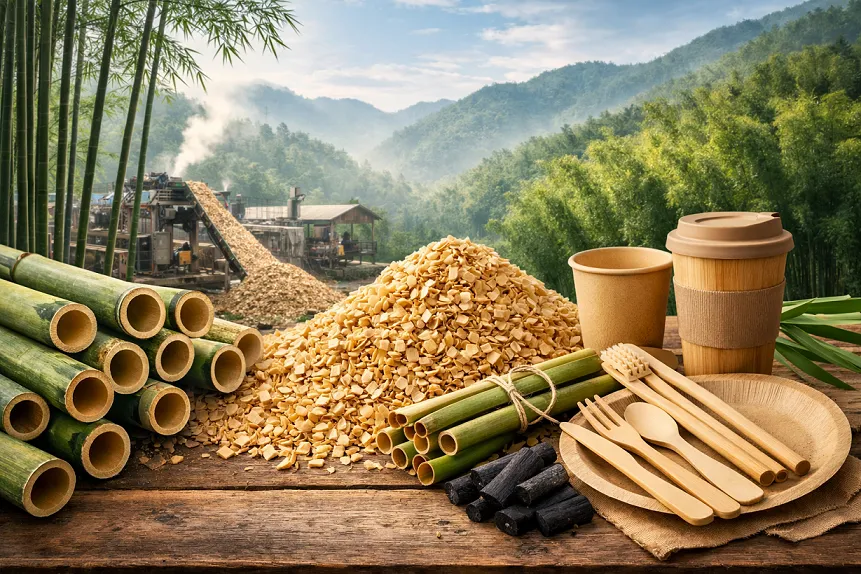
Rolling green mountains and vast bamboo forests stretch as far as the eye can see. Amid the roar of machinery, raw moso bamboo is rapidly processed into millimeter-sized bamboo chips. These chips are transported out of the mountains and used as substitutes for plastic, eventually transformed into finely crafted tableware.
This scene takes place in Baimao Village, Liuhe Town, Qichun County, Hubei Province. Chen Hu, Party Secretary of Liuhe Town, told reporters that the bamboo-based plastic alternative raw material processing project in Baimao Village was introduced last year by the local government as a green, income-generating initiative. The project officially began operations on June 30.
Deep in the Dabie Mountains, Liuhe Town represents a microcosm of the rapidly expanding “bamboo instead of plastic” industry across China. So, what is the current development status of this emerging industry nationwide?
Traditional plastic manufacturing relies heavily on non-renewable resources, consumes large amounts of energy, and causes severe environmental pollution—an issue that has become a global consensus.
According to statistics, approximately 400 million tons of plastic waste are produced globally each year. China is the world’s largest producer of plastics, accounting for about 30% of global plastic output. By 2050, global plastic production is expected to reach 1.24 billion tons. Of all plastic products produced worldwide, only 9% are recycled, 12% are incinerated, and the remaining 79% are landfilled or discarded. By 2050, accumulated plastic waste is projected to reach 12 billion tons. Plastic pollution and microplastics pose serious threats to human health and ecosystems.
Bamboo, as an environmentally friendly, renewable, and biodegradable biomass material, grows rapidly and is widely distributed around the world. It also has excellent mechanical properties and strong carbon sequestration capacity, making it an ideal substitute for plastic.
China’s 14th Five-Year Plan for Plastic Pollution Control calls for the scientific and steady promotion of plastic alternatives. In June 2022, “bamboo instead of plastic” was included in the outcomes of the Global Development High-Level Dialogue. In November 2023, the Chinese government and the International Bamboo and Rattan Organization jointly released the Global Action Plan on Bamboo as a Substitute for Plastic (2023–2030) at the first international academic symposium on the topic.
In October 2023, the National Development and Reform Commission, the Ministry of Industry and Information Technology, the Ministry of Finance, and the State Forestry and Grassland Administration jointly issued the Three-Year Action Plan for Accelerating the Development of Bamboo as a Substitute for Plastic. The plan proposes that by 2025, an initial industrial system will be established, with improvements in product quality, variety, scale, and overall benefits. Compared with 2022, the comprehensive added value of major bamboo-based plastic alternative products is expected to increase by over 20%, and the comprehensive utilization rate of bamboo materials is expected to rise by 20 percentage points.
According to the National Bamboo Industry Development Plan (2021–2030) released by the China Bamboo Industry Association, the total output value of China’s bamboo industry is expected to exceed RMB 1 trillion by 2030, with major bamboo products entering the high end of the global value chain, positioning China as a global powerhouse in the bamboo industry.
China enjoys unique advantages in developing the “bamboo instead of plastic” industry.
China is home to 39 genera and 837 species of bamboo, accounting for 51% of the world’s total bamboo species. According to the Ninth National Forest Resources Inventory, China has approximately 109.373 billion standing bamboo culms, with bamboo forests covering 6.4116 million hectares. Bamboo forests account for 0.70% of the country’s total land area, 1.98% of forest land, and 2.94% of total forest area. Compared with the previous inventory, bamboo forest area increased by 405,300 hectares, and the number of standing bamboo culms increased by 25.016 billion.
Leveraging abundant bamboo resources and a solid processing foundation, major bamboo-producing regions across China are promoting coordinated development across the entire industrial chain. A comprehensive bamboo industry system featuring diverse product categories and business models has gradually taken shape. Currently, China has more than 10,000 bamboo processing enterprises. In 2024, the total output value of the bamboo industry exceeded RMB 500 billion, with bamboo product imports and exports reaching USD 2.3 billion.
In terms of application research, China has developed bamboo-based engineering materials such as bamboo-wound composite pipes, utility tunnels, and bamboo lattice fillers for cooling towers used in construction and industrial fields. Innovative products such as bamboo fiber food containers, bamboo straws, and bamboo cutlery have been successfully commercialized. Durable bamboo alternatives, including outdoor materials, decorative panels, and household products, as well as bamboo charcoal-based materials with adsorption, energy storage, and filtration functions, have also entered large-scale production.
Bamboo straws represent a successful example of bamboo replacing plastic. Yang Dezhen, General Manager of Anhui Hongye Group, noted that plastic straws are among the most widely used plastic products. China produces approximately 46 billion plastic straws annually, most of which are made of polypropylene and are non-biodegradable. Due to their small size and low recycling value, plastic straws cause severe environmental pollution. Today, domestically produced bamboo straw forming equipment can operate with fully automated feeding and discharging, multiple drilling tools working simultaneously, and a production capacity of over 2,000 straws per hour with a qualification rate exceeding 99%.
Despite encouraging progress, challenges remain in fully leveraging China’s bamboo resource advantages.
Although China ranks first globally in bamboo resources, forest area, bamboo reserves, production, and export volume, the overall utilization rate of bamboo resources is only about 20%. Even moso bamboo, the most developed species, has a utilization rate of less than 30%. Only around 20 bamboo species—about 2.5% of all bamboo species—have been commercially developed. Approximately 50% of bamboo forests are low-yield and low-efficiency, while intensively managed bamboo forests account for only about 30%.
Most bamboo processing enterprises are labor-intensive small or micro-businesses, with low levels of mechanization and automation. Processing often relies on standalone machines, lacking continuous and integrated production equipment. As a result, enterprises generally have limited comprehensive strength and weak risk-resistance capabilities.
Since the launch of the national three-year action plan, local governments have introduced supporting policies. Further efforts are needed to strengthen financial support, particularly for equipment R&D, product manufacturing, and patent technology transfer related to bamboo-based plastic alternatives.
Currently, bamboo-rich provinces such as Fujian, Jiangxi, Hunan, and Sichuan have formed preliminary regional industrial clusters. However, large leading enterprises remain scarce, industrial chain coordination is weak, and agglomeration effects have yet to fully materialize.
In September 2024, the State Forestry and Grassland Administration released a specialized standard system for bamboo-based plastic alternatives, covering nine categories and 140 standards. In July 2025, it jointly issued the Catalogue of Major Bamboo as a Substitute for Plastic Products (2025 Edition), expanding application scenarios to include sports equipment, safety protection products, and transportation warning devices, such as bamboo golf tees, skateboards, fitness bars, helmet shells, guardrails, and road cones.
According to officials from the State Forestry and Grassland Administration, future efforts should focus on large-scale, intensive production and the development of industrial clusters. Emphasis should be placed on leveraging regional strengths, promoting scale operations, building professional teams, and optimizing industrial layout. Accelerating innovation in intelligent harvesting equipment, green and low-carbon processing technologies, and high-performance bamboo products will be critical to cultivating new quality productive forces and improving the conversion of scientific achievements into commercial value.
“Achieving the healthy development of the ‘bamboo instead of plastic’ industry ultimately depends on enhancing market competitiveness and cost control,” the official said. “This requires coordinated efforts between government and enterprises to address the core factors influencing market share and cost competitiveness.”